
To understand project management, we must first examine the concept of a “project.” According to the U.S.-based Project Management Institute (PMI), a “project” is an endeavor with a start and end date that results in a unique product. In other words, every project has its own unique characteristics, and each project requires specific preparation and must be managed accordingly. The success rate of projects that are not properly planned and managed using appropriate methods is very low.
Although project management may appear as a collection of documents and a system, it is also one of the best examples of teamwork. Teams that know and support one another, combined with systems that have been tested and proven in previous projects, accelerate all processes. However, having good teams alone does not guarantee success in projects. To ensure success, essential elements include documentation that allows for accountability to all stakeholders after each action, a detailed Project Management Plan tailored to the project, and a Central Document Control System (DCC) that is easy to control and access.
Due to their multi-stakeholder structure (client, designer, consultant, contractor, supplier, operator, etc.), construction projects involve highly complex management processes. Centralized information collection and distribution play a critical role in ensuring projects meet their cost, schedule, and scope objectives. For example, a change proposed by the designer must be reviewed in terms of schedule, cost, and constructability; confirmed by all relevant stakeholders; and finally approved by the Client. If all these processes are managed by a Project Management team, the process will not only be completed more quickly and achieve the intended outcome but will also prevent schedule delays and/or cost overruns that could arise in later phases of the project as a result of hasty or incorrect decisions.
The general sequence of operations for construction projects is as follows:

Project Management can begin or end at any point in these processes; however, to ensure a successful project outcome (where the scope is fulfilled and the project is completed on time and within budget), the Project Management firm must be involved in the process prior to the selection of a designer and remain actively engaged throughout the process until the project is handed over to the end user.
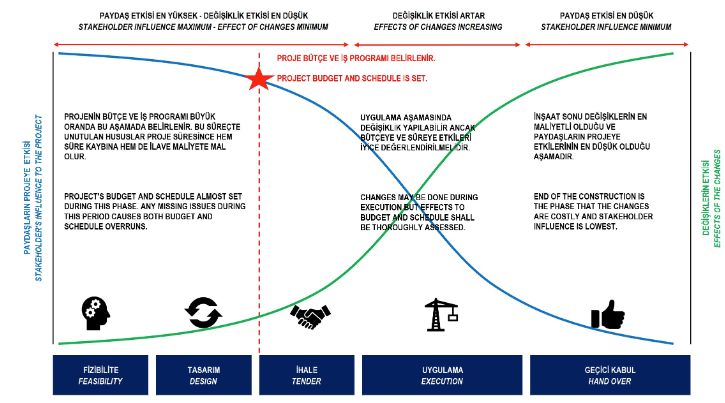
As can be seen from the graph, the design phase of a project is a process in which stakeholder influence is high and the impact of changes on the project is low, compared to the construction phase. These effects reverse as the project nears completion, with stakeholder influence reaching a minimum and the impact of changes reaching a maximum by the project’s end. Furthermore, if the design phase—during which nearly 70% of the project’s duration and cost are determined—is not managed properly, future changes could impose significant burdens on the project budget and lead to project delays.
The design phase is also the primary planning phase for construction projects. This is generally the process during which both the project budget and the work schedule are established. The project management firm’s most important contribution during this process is the preparation of the project risk register. The accurate definition of these risks—which will be used throughout the preparation of both the budget and the work schedule—and their quantification (in terms of days for the work schedule, cost for the budget, etc.) are essential steps for creating an accurate budget and work schedule. Unrealistic budgets and/or work schedules cause numerous problems during the project and make it difficult for clients to make decisions. Since it is impossible to define how to mitigate unidentified risks, responding to a risk when it arises can be both costly and lead to delays. Risks also evolve as the project progresses. The risk register is periodically updated throughout the project, and budget and schedule projections are adjusted accordingly. If deviations from the project’s objectives are not detected in a timely manner through accurate projections, taking corrective action may become impossible.
In summary, if project management is integrated into the project at the right time using the right systems, it ensures planning and coordination at the highest level. This increases the likelihood of the project achieving its objectives (time, cost, scope, quality, occupational safety, etc.).
Mert Güven, Civil Engineer, PMP